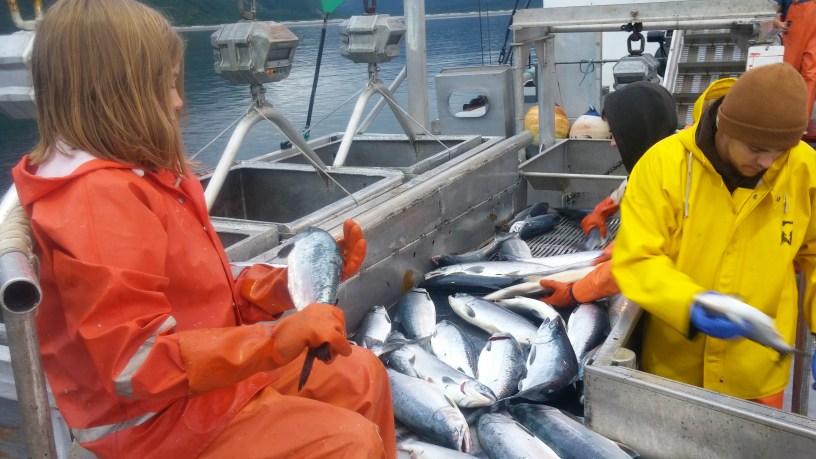
It’s 12:30 am and the last fish boat has just pulled up to unload. Not being crew I was able to peel off to head to bed, but they are all out there working. This is the nature of tendering. It happens at all sorts of hours. I am learning – the fish industry functions regardless of the weather. Today it was blowing a steady 40 knot wind with some spitting rain here and there. We were out there buying fish. Such is the life of a tender. Time becomes nebulous – work and sleep don’t have a set schedule.
Before coming on this boat I really had no concept or visual for what happened on a tender. I knew they buy and sell fish. It’s more than that: there is sorting, weighing and moving thousands of pounds of fish. 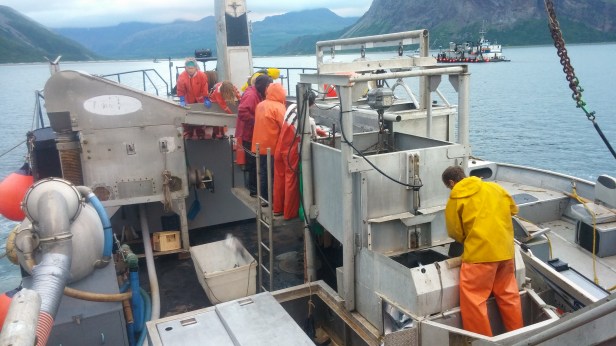
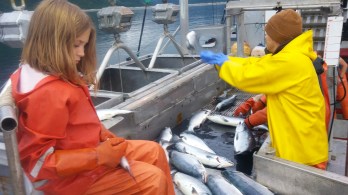 Bailey, my 8-year-old mentor, is showing me the ropes and teaching me how to sort salmon. Her job is taking temperatures. This has to be done at least 3 times during the pumping to ensure the fish have been kept appropriately cold in the holds. Cold temps mean better quality fish. The holding tanks are held at temps slightly above 32 degrees.
The salmon are sucked out of the fish boat with a huge vacumn tube to a sorting table. Here they are tossed into bins based on species and weighed.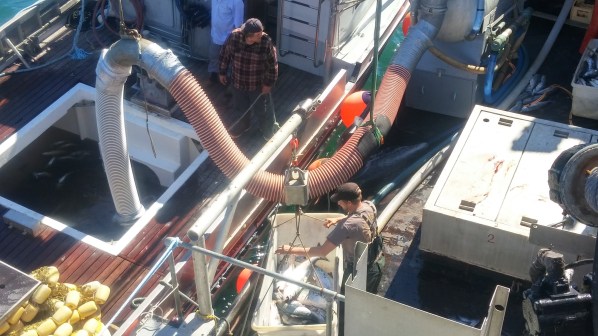 The sorting is wild. Fish come flying down the table and in a few seconds I’m supposed to identify the sockey from the dogs, silvers, pinks and kings. I’ve been given the criteria:
 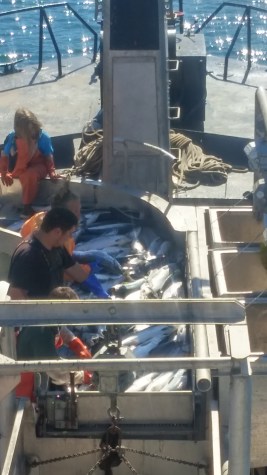 pinks have spots on their tales and they get the hump, dogs have the tiger stripes and no spots, silver have silver in their tails, Kings have silver and dots in their tails and sockey – they are red or plain. It’s a blur; all these slippery silver fish in various states of spawning (which by the way changes their appearance). I started to get it by the 3rd boat. And Bailey, like a good teacher would pull out a few each round and say “what fish is this?” and correcting me by pointing out key details if I was wrong.
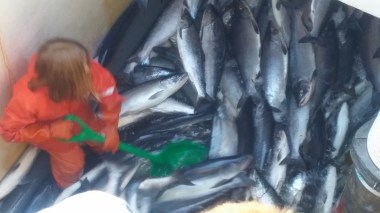
There are other fish like Pollock that get caught in the nets – we pull these and toss them over the side. My fish expert Bailey has taught me some cool stuff like Pollock have ivory in their gills! Yes – you can pop these ivory chips out of the cheeks. She has a pretty good collection going that we added to tonight. She shared with me that she wished people would use this ivory and leave elephants alone. Sound reasoning to me! There was also a flounder in the mix tonight. 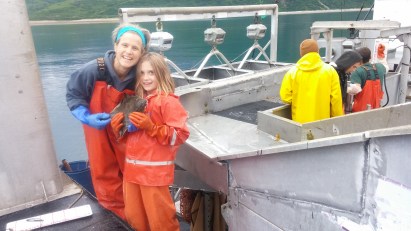 They are one cool fish! Their bodies have a
really rough texture. The flounder was still alive and we returned him back to the sea. That felt good among all these fish meeting their demise.
When the salmon come in still alive and they are flopping around on the sorting table or in the bins, I feel uneasy. I am not against the fishing – I like eating salmon! But I am aware that this is a life I’m taking and it is difficult to see the fish suffer. It’s an interesting dance to do. I asked some of the other crew about it, assuming they were used to it and going to tell me to “suck it up”. I was comforted to hear some voice similar feelings. I land on the reality that to eat, things have to die. We can do our best to be respectful and have gratitude for the catch and minimize suffering, but it is a part of the process. I am certain I will see the salmon I buy at the grocery store differently in the future.
 Mirczak's Magical Year