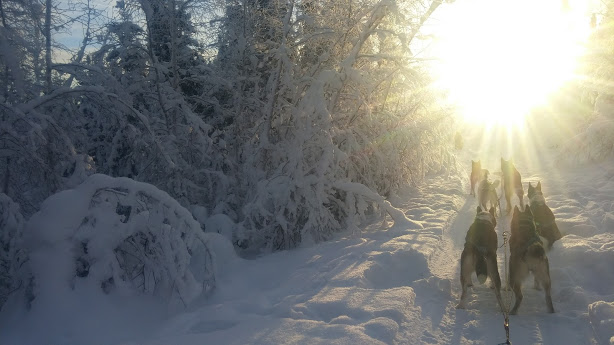
My original thoughts on dog mushing: You have a team of dogs, they pull the sled with you on it, you tell them where to go and they follow your instructions. That’s what happens on a good day. I hadn’t really thought about what goes into creating a team or what it takes to have it run smoothly. When I arrived in December, part of my work agreement was taking care of Mary’s dog team. I proudly refer to myself as her Dog Handler. This title actually can carry clout. Dog mushing is BIG here in Alaska and kennels will hire people to be dog handlers. They feed, groom, scoop poop and may even run dogs for exercise. Like any profession the more you do it and learn about it the better you understand your work. I was a total newbie to sled dogs. (remember I had a cat! )
A brief primer on dog mushing:
People usually ask “What makes a good leader?” From what I learned it starts by having a good relationship with the dog and it helps if the dog has some smarts. Trust is a big part of it for both the musher and the dog. There are universal commands in mushing “Gee (go right) Haw (go left) Whoa (stop) and On by (pass by something)” Usually mushers train a dog to lead by running them side by side with a solid leader. IF you don’t happen to have a solid leader, you need to train your dogs to lead. Like obedience training it takes repetition, reward and time.
Another method for training your team …. have them follow another team. Dogs are chasers and if there is a team in front they will run like crazy to catch them.
Now… truth is you usually don’t have a problem getting a team to run, especially if they have something to chase. Where the challenge comes is getting them to stop! Remember a typical sled dog can pull 100 lbs. If you have 4 dogs, that’s a lot of power. If you have 8 that’s A LOT of power. 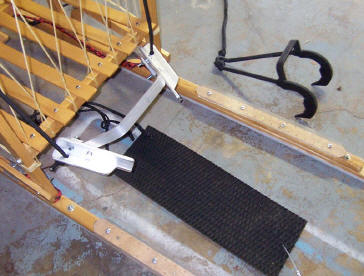 All dog sleds have a break, (it’s usually got carbide tips for grabbing hard snow or ice) a drag, (something you stand on to help slow the team) Snow hooks (for burying in snow) and a snub line to tie the sled to a tree or anchor. You need ALL OF THESE to have control of your team. Where most of the problems/accidents and good stories come from in dog mushing ,is not being able to stop the dogs. Why?
- Dogs will fight
- Dogs LOVE to chase Moose
- Dogs like to chase squirrels
- Dogs like to chase anything!
- Trails can have steep down hills
- Trails can have 90 degree turns!
And all of these things I learned when I started to run my own dogs.
So here is my set up: I have 4 dogs, NO specific leader, a BIG down hill in the first 1/4 mile of the trail leaving my yard and LOTS of moose in the area. Can you say calamity and comedy rolled in one! (Did I mention that the down hill also has a tree leaning across it that I have to duck under or risk decapitation!?)
The basket sled I use is small and light. I can only run 2 dogs at a time unless I want to experience complete lack of control. Depending on who I run together, I can barely stop 2 dogs! It is inevitable that a musher will be dragged at some point behind their sled by the dogs. If you are lucky you won’t let go and be stranded as your team runs off. In that situation you REALLY are lucky if your sled turns on its side or the snow hooks toss out and catch stopping the team. As I mentioned, it’s a good day when the dogs do what you ask and you all come back in one piece! It’s a typical day for me when the dogs chase something or I get dragged some distance. What is that saying… “That which doesn’t kill you makes you stronger”?
My learning to run dogs on my own has been a comedy of errors but I am proud to report: I haven’t broken a sled, any bones or lost a dog …. so far. I have always come back in one piece bringing some tale of “what I learned today”.


Heather! I love how much I learn from reading your posts and yet they are so FUN to read too! Thank you for sharing your experience this way. I really feel like I’m getting to reap some of the reward of your sabbatical. Sending big love to you in Alaska.
LikeLike
My previous message doesn’t seem to show my real name: it’s me, Kelly Violette. (-:
LikeLike
You are so Awesome! I was wondering who that e-mail belonged to! I am honored that you are reading them – while on your own AMAZING adventure of parenthood! I wonder how that is going????
LikeLike
Love your stories: you write very well and (from my 30 years of running dogs) you are right on target in your descriptions and explanations. It was an addiction I loved having.
LikeLike
HI! Thanks Judi! I hope to connect with you when I’m back up there. It was a full on spring. Ridiculous how life can get so busy even when you don’t have a job!
LikeLike
Very very cool. I love that you take the time to do this.
LikeLike